The Seven Trumpet Judgments
Book of RevelationThe Seven Trumpet Judgments are a staged sequence of disasters in Revelation, in which seven angels sound their trumpets and the damage intensifies from ecological destruction to mass death. The author treats their placement in the book as a key to his larger chronology: he argues that the trumpet visions follow the saints’ arrival before God’s throne and occur during the period of divine wrath, after the rapture he locates at the opening of the seventh seal.
Background and Chronological Placement
The book presents the trumpet sequence after a dramatic transition: seven angels receive trumpets, while another angel offers incense together with the prayers of the saints at the golden altar before God’s throne. The angel then fills a censer with fire from the altar and casts it to earth. Thunder, lightning, voices, and an earthquake accompany this action, after which the seven angels prepare to sound. The judgments therefore emerge from a heavenly scene that links the prayers of the saints with the onset of disasters on earth.
The author emphasizes that Revelation is not entirely arranged in chronological order. In his view, treating every chapter as a simple continuation of the preceding one has encouraged competing interpretations, including at least five proposed timings for the rapture. He argues that the trumpet passages belong after the gathering of the saints described in Revelation 7:9–8:1. His case draws on the opening of the seventh seal, when the trumpets are given to the angels, and on the sequence he sees between the saints arriving before God’s throne and the judgments that follow.
This placement supports the author’s mid-tribulation interpretation. He distinguishes an initial period of tribulation from the later outpouring of God’s wrath, while allowing that readers may use different labels for those two halves so long as they recognize a total seven-year period. In this scheme, the trumpet judgments are not evidence that the saints remain on earth throughout the wrath: the author regards the church as already gathered to safety before the judgments unfold. This is his interpretive framework, rather than an explicit statement in each trumpet scene.
The First Four Trumpets
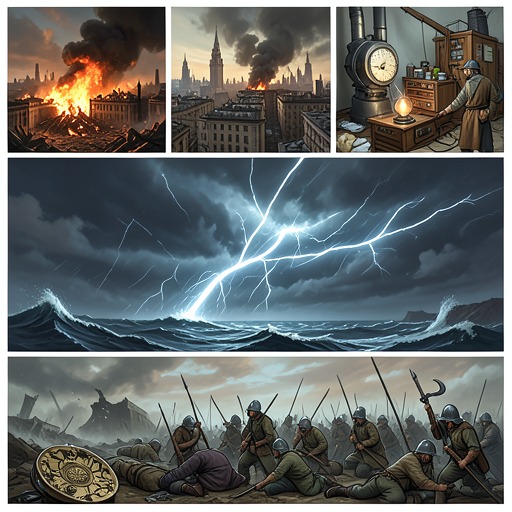
The first four blasts strike the created world in a repeated pattern of partial devastation. At the first trumpet, hail and fire mixed with blood fall upon the earth; a third of the trees burn, along with all the green grass. The second trumpet brings what appears like a great mountain burning with fire into the sea. A third of the sea becomes blood, a third of its living creatures die, and a third of the ships are destroyed. The repeated fraction marks the scale of the calamity, while also distinguishing it from total destruction.
The third trumpet shifts the disaster from sea to fresh water. A great star, burning like a lamp, falls upon a third of the rivers and springs. Its name is Wormwood, and the waters become bitter; many people die after drinking them. The fourth trumpet darkens the heavens: a third of the sun, moon, and stars is struck, leaving a third of the day and night without light. The sequence thus moves across land, sea, water sources, and the sky, making the environment itself a medium of judgment.
After these four blasts, an angel flies through the middle of heaven and warns the inhabitants of the earth that three woes remain, corresponding to the final three trumpets. The author reads this interruption as an announcement that the most severe judgments are still ahead. It also divides the sequence: the first four judgments damage the natural world, while the last three bring direct and sustained suffering to people.
The Fifth and Sixth Trumpets
At the fifth trumpet, a star falls from heaven and receives the key to the Abyss. When it opens the pit, smoke rises like smoke from a great furnace and darkens the sun and air. Locust-like creatures emerge from the smoke, but their permitted target is restricted: they are not to harm grass, greenery, or trees, only people who lack God’s seal on their foreheads. They may torment, but not kill, and their torment lasts five months. The account says that people will seek death without finding it, a contrast that makes the limit on the creatures’ power part of the terror of the episode.
The creatures are described with features that combine human, animal, and military imagery. Their shapes are like horses prepared for battle; they have something like golden crowns, humanlike faces, iron breastplates, and wings whose sound resembles chariots rushing into battle. Their tails resemble scorpions and carry stings. They have a king, identified as the angel of the Abyss, called Abaddon in Hebrew and Apollyon in Greek. The author characterizes this trumpet as wicked and stresses its five-month duration, using that stated period to challenge interpretations that make the time of wrath very brief.
The sixth trumpet turns from prolonged torment to a vast killing force. A voice from the four horns of the golden altar commands the sixth angel to release four angels bound at the Euphrates River. They have been prepared for a specific time—an hour, a day, a month, and a year—to kill a third of humankind. The vision gives the number of the mounted army as two hundred million. Its horses have heads like lions, and fire, smoke, and sulfur issue from their mouths; these three plagues account for the deaths of a third of humanity. The horses also have serpent-like tails with heads, which inflict harm.
The author infers that the appointed time may mean the sixth trumpet’s military campaign lasts as long as a year, while presenting this as an impression drawn from the wording rather than a directly specified duration. He contrasts the vision with total destruction: the passage depicts a powerful force killing a third of humanity, not the annihilation of all people. Those who survive nevertheless do not repent of their deeds or stop worshipping idols. The judgment’s consequence is therefore not only death on an immense scale but also the stated persistence of idolatry among the survivors.
The Seventh Trumpet and Its Interpretation
The evidence presented by the book’s author treats the seventh trumpet differently from the first six. He notes that Revelation 10:7 announces the completion of the mystery of God when the seventh angel begins to sound, without specifying the judgment’s full contents. He reads this as possibly signaling events concerning God’s elect in heaven. Revelation 11:15 likewise sounds to him like a heavenly event, perhaps associated with the marriage supper of the Lamb. These are expressly interpretive possibilities, not details the trumpet passage itself fully explains.
The seventh-trumpet material also announces that the nations are angry, God’s wrath has come, and the time has arrived to judge the dead, reward God’s servants and those who fear his name, and destroy those who destroy the earth. The heavenly temple opens, revealing the ark of God’s covenant, followed by lightning, voices, thunder, an earthquake, and great hail. The author reads the scene as holding judgment and reward together: the saints’ reward and the destruction of those who reject Christ are presented within the same announcement.
He connects the scene’s closing signs to the beginning of the trumpet judgments. Revelation 11:19 describes lightning, thunder, an earthquake, and hail; Revelation 8:5–7 repeats lightning, thunder, an earthquake, and hail before the first trumpet sounds. For the author, this recurrence helps locate the passage about the seventh trumpet near the opening of the period of wrath, even though the vision’s arrangement is not, in his account, a straightforward chronological sequence. He further places the seventh-trumpet material after the saints’ arrival at the throne, making the transition from heavenly gathering to earthly judgment central to his reading.
Significance in the Book’s Argument
The trumpets give the author a framework for arguing both about sequence and duration. Their arrangement lets him distinguish the first four judgments from the three announced woes, and the fifth and sixth trumpets supply concrete time markers: five months of torment and a force appointed for an hour, a day, a month, and a year. The figures and recurring fractions do not, by themselves, establish every chronological conclusion he draws, but they are central to his effort to describe the wrath as a sustained period rather than a single brief catastrophe.
The sequence also supports his broader claim that Revelation must be read by comparing visions and recurring details, not by assuming that each chapter follows the last in strict order. He places the saints’ gathering before the trumpet disasters and understands the seventh trumpet’s heavenly announcements alongside the earthbound judgments. In this interpretation, the judgments’ escalating damage and the repeated distinction between the sealed and unsealed, the dead and surviving, and the rewarded and condemned give the trumpet cycle its organizing contrasts.